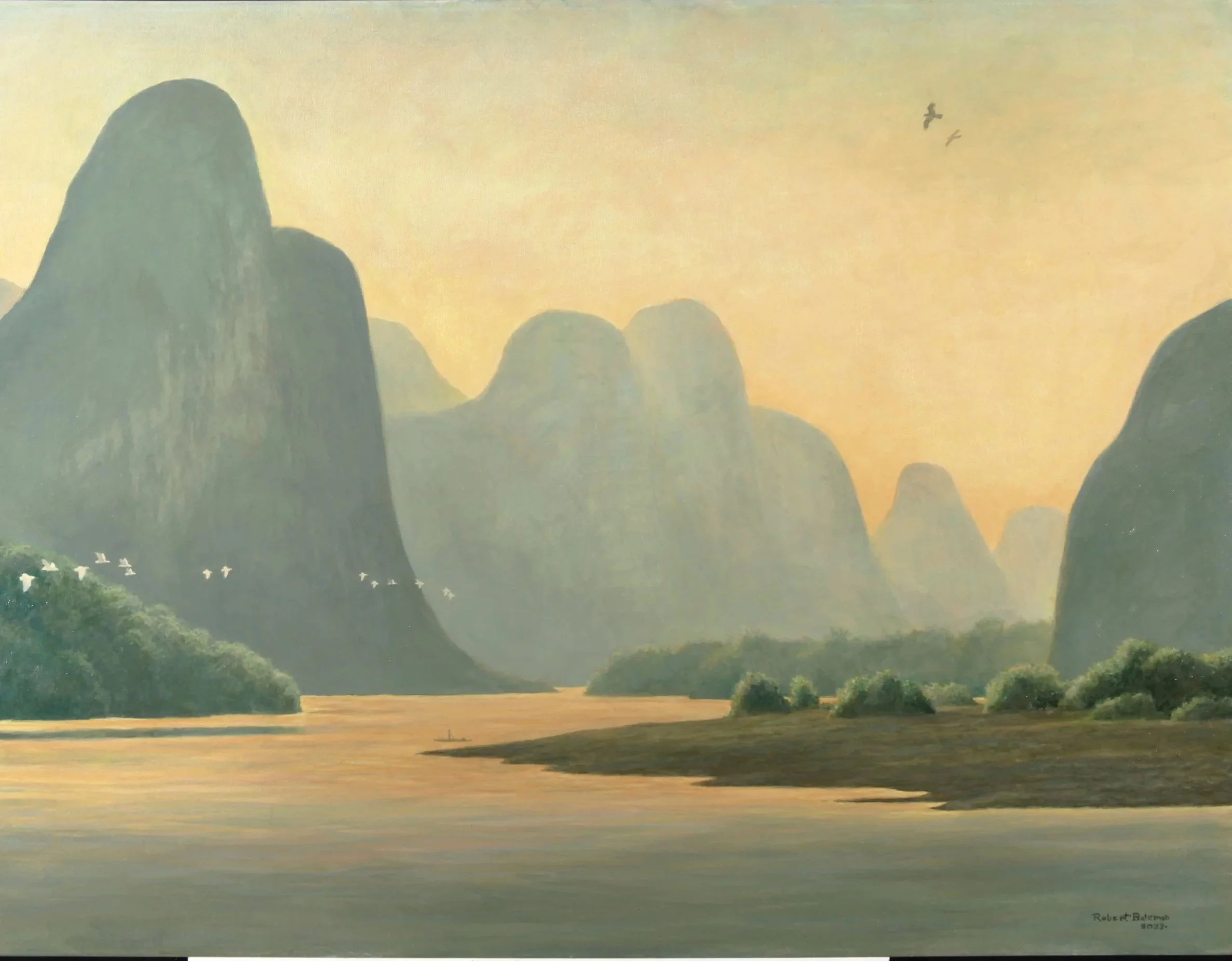
“Li River”
Robert Bateman (b. 1930)
Acrylic on Canvas
2023
Signed and dated
30 x 40 in.
$40,000 USD
From Robert Bateman:
The Li River is one of about a thousand UNESCO World Heritage Sites in the world, so designated because of it's unique beauty. It is not the river but the surrounding hills that inspire the human eye. The geology is limestone that has been eaten away by erosion from the sides, creating tall, narrow, thumb-like hillls. The area is set aside from human development to keep its natural appearance. Very limited human activity is allowed, such as traditional fishing.
This painting shows a lone fisherman on a bamboo raft with a cormorant as his fishing 'tool'. The bird has a leash and a collar which is too tight to permit a caught fish to be swallowed. Periodically, the cormorant is rewarded with one of the fish.
Background:
This is a UNESCO World Heritage Centre ...
"In 1982 the State Council listed the Lijiang River Scenic Zone at Guilin among the first group of the major places of scenic and historic interest, which is now in the charge of the Administrative Bureau of the Lijiang River Scenic Zone at Guilin. The landforms of Guilin can be divided into four categories but corrosion takes the main part of the four, that means the low-lying land of peaks and plains of peak forests are the landform features of Guilin; then the corrosion landforms of hillock and gentle slope hillock; eroding landforms of ridge, ravine; and accumulation landforms of every terrace. The stone mountains, mainly of limerocks, of Guilin are composed of marine biochemical sediments. Years of weathering and water erosion have given shape to the rich and varied patterns of its present peaks, either in isolation or in cluster, and magnificent karst caves.
"The Lijiang River starts from Mao'er Mountain. The section of the river from the confluence of the Darong River to Pingle is the Lijiang River. It flows through Guilin and Yangshuo with a total length of 116 kilometers and a catchment area at its upper reaches of 2,860 square kilometers." https://whc.unesco.org/en/tentatihttps://whc.unesco.org/en/tentativelists/108